The puddle is gone. The towels are in the wash. You ran a fan for a couple days and the carpet seems okay when you walk across it. So the water damage is handled, right?
Not even close.
What you can see and feel with your bare feet tells you almost nothing about the moisture trapped inside your walls, under your subfloor, and above your ceilings. Water travels through building materials by capillary action — essentially wicking through the tiny pores in wood, drywall, and concrete the same way a paper towel absorbs a spill. The surface dries first while the core stays wet. And that hidden moisture is where mold starts, wood rot begins, and structural integrity quietly degrades.
Professional structural drying in Philadelphia, PA is not about making things look dry. It is about making them measurably dry, all the way through, verified by data.
Structural drying is the controlled process of removing moisture from building materials — wall studs, subfloor sheathing, floor joists, concrete slabs, and insulation — using commercial-grade equipment and measured airflow strategies. The goal is to bring every affected material back to its equilibrium moisture content, which is the normal moisture level that material would hold in your Philadelphia, PA climate without any water damage present.
This is where a concept called psychrometry comes in. Psychrometry is the science of how air temperature, humidity, and moisture interact. Here is the simplified version: warm air holds more moisture than cold air. A dehumidifier pulls moisture out of the air, lowering the humidity. Air movers push that drier air across wet surfaces, encouraging moisture to evaporate from the material into the air stream. The dehumidifier then captures that moisture again. This cycle repeats continuously until the materials are dry.
The key detail most people miss is that dehumidifier type matters enormously. A standard refrigerant dehumidifier you buy at a hardware store pulls maybe 30 to 50 pints per day and works best in warm conditions. A commercial Low Grain Refrigerant dehumidifier — called an LGR — can pull 17 to 20 gallons per day and continues working efficiently even as relative humidity drops below 40 percent. For large-scale water events or Philadelphia, PA properties with concrete slab foundations, we may deploy desiccant dehumidifiers that use silica gel rotor technology to achieve extraordinarily low humidity levels that accelerate drying in challenging materials like concrete and plaster.
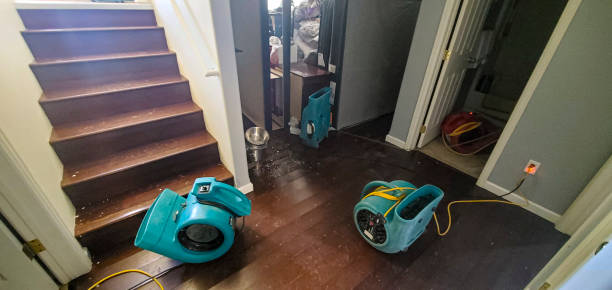
Equipment placement is not random. Every air mover has a specific position based on the room geometry, the type of wet material, and the location of the dehumidifier's intake and output. Pointing a fan at a wall does not dry the wall evenly. Positioning an air mover at a 15-degree angle against the baseboard creates a laminar airflow across the surface that maximizes evaporation across the entire wall face. These details are the difference between a three-day dry and a seven-day dry.
Before we place a single piece of equipment, we map the moisture. Every wall, every floor section, every ceiling plane in the affected area gets tested with penetrating and non-penetrating moisture meters. Pin-type meters drive two small probes into the material and measure electrical resistance between them — wetter material conducts electricity more easily, giving us an exact moisture content reading. Non-penetrating meters use radio frequency signals to scan below surfaces without making holes, allowing us to quickly identify wet zones across large areas.
We record all of these readings on a diagram of your Philadelphia, PA property. This is the moisture map. It shows us exactly which areas are wet, how wet they are, and where the boundaries of the affected zone lie. It also becomes our daily tracking tool. Every 24 hours, we return and re-test every mapped point. We are looking for grain depression — the difference between the moisture content of the air and the moisture content of the material. As long as the material is wetter than the air, evaporation continues. When the material's moisture matches the target dry standard for your region, that section is cleared.
This data-driven approach prevents two problems. First, it stops us from removing equipment too early. Surface-dry materials that still read wet on a meter will grow mold within days if the drying equipment is pulled. Second, it prevents us from leaving equipment running unnecessarily long, which saves you money on the project duration.
We get calls every month from Philadelphia, PA homeowners who thought their water damage was resolved. They cleaned up the visible water, ran fans for a day or two, and moved on. Three weeks later, they notice a musty smell. Six weeks later, they see dark spots forming on their baseboards. Two months later, a mold inspector finds extensive colonization behind the drywall.
At that point, the remediation project is dramatically more expensive than proper drying would have been. Walls that could have been dried in place now need to be demolished. Framing that needed four days of airflow now needs antimicrobial treatment and possibly replacement. The original water damage that might have cost a couple thousand dollars to dry professionally has turned into a ten-thousand-dollar mold remediation and rebuild.
Proper structural drying in Philadelphia, PA is not a luxury. It is the most cost-effective way to prevent a small water event from becoming a large-scale restoration project.
The water is gone from your Philadelphia, PA floor, but is it gone from inside your walls? From under your slab? From above your ceiling? The only way to know is to measure. And the only way to fix it is with commercial drying equipment operated by someone who understands the science of moisture movement.
Call 1-833-541-0100. We will come out, run a full moisture assessment of your Philadelphia, PA property, and show you exactly where the wet spots are. If everything is dry, we will tell you and you will have peace of mind. If it is not, we will get the right equipment in place before mold has a chance to take hold.
"A failed dishwasher supply line soaked our kitchen and dining room. GBS quickly arrived, used pin meters and moisture mapping to find hidden water three feet high behind the cabinets, and set up air movers and dehumidifiers. This saved our cabinets and flooring and revealed how far the water traveled."
"The toilet supply line cracked on our second floor in Philadelphia, PA. The team used moisture mapping to locate hidden water in the ceiling and joists, then vented the trapped moisture without tearing everything out. Their smart approach saved us thousands in drywall replacement."
"I tried drying my Philadelphia, PA basement myself with a box fan, but two weeks later, I smelled mold. GBS Restoration found soaking wet wall studs my store-bought equipment couldn't reach. They dried the framing properly in three days, proving professional drying is essential."
Philadelphia, commonly referred to as Philly, is the most populous city in the Commonwealth of Pennsylvania and the second-most populous city in both the Northeast megalopolis and Mid-Atlantic regions after New York City. It is one of the most historically significant cities in the United States and served as the nation's capitol until 1800. Philadelphia is the nation's sixth-most populous city with a population of 1,603,797 as of the 2020 census. Since 1854, the city has been coextensive with Philadelphia County, the most populous county in Pennsylvania, and the urban core of the Delaware Valley, the nation's seventh-largest and one of the world's largest metropolitan regions with 6.245 million residents. Philadelphia is known for its extensive contributions to American history, especially the American Revolution, and for its contemporary influence in business and industry, culture, sports, and music.
Zip Codes in Philadelphia, PA that we also serve: 19154 19151 19150 19153 19152 19102 19103 19106 19107 19104 19108 19109 19128 19129 19120 19121 19122 19123 19124 19125 19126 19127 19112 19111 19115 19114 19116 19119 19118 19148 19149 19146 19147 19144 19145 19142 19143 19140 19141 19139 19138 19137 19136 19135 19134 19133 19132 19131 19130 19019 19092 19093 19099 19101 19105 19110 19155 19160 19161 19162 19170 19171 19172 19173 19175 19176 19177 19178 19179 19181 19182 19183 19184 19185 19187 19188 19190 19191 19192 19193 19194 19195 19196 19197 19244 19255